
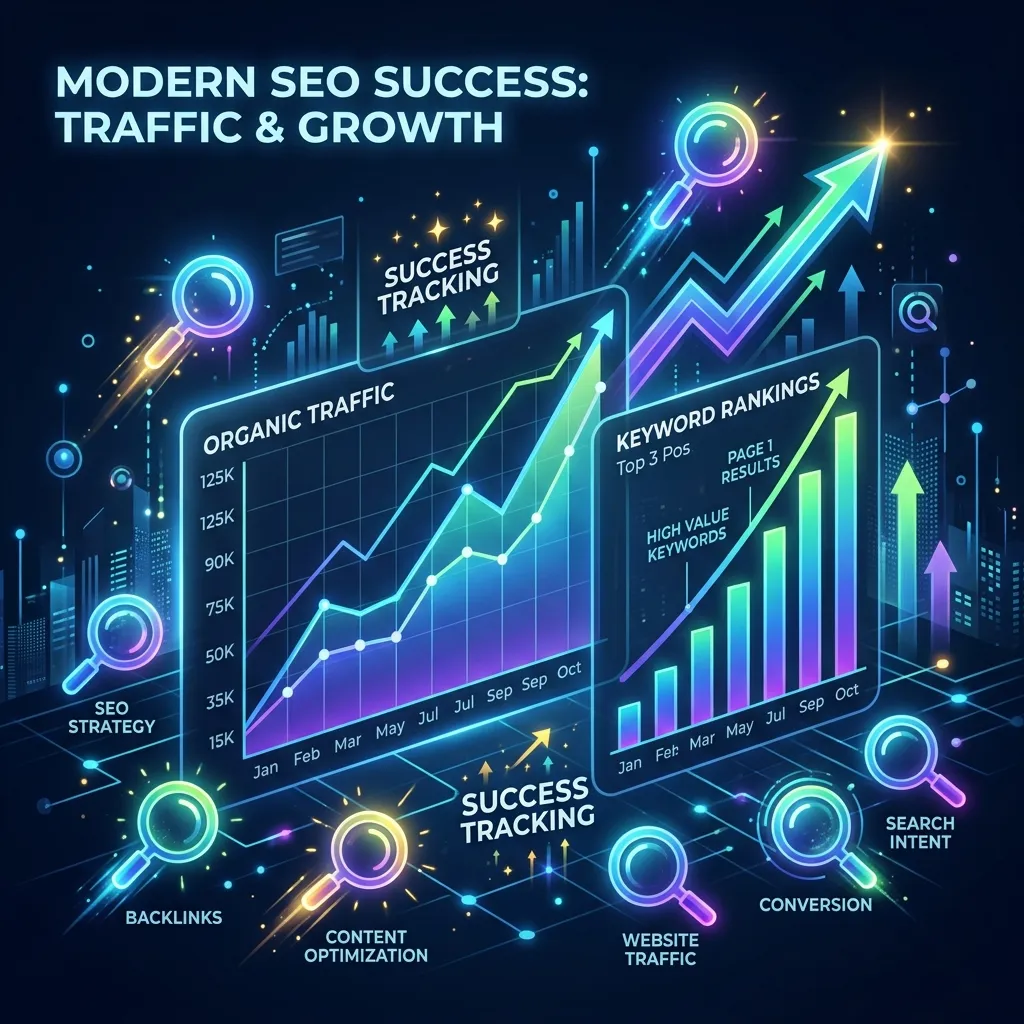
SEO — Search Engine Optimization — is the process of making your website visible to people searching for your products or services on Google. For small businesses, SEO is the most cost-effective marketing strategy available: it generates free, targeted traffic from people actively looking for what you offer. This guide explains the fundamentals in plain language.
What Is SEO and Why Should You Care?
When someone searches "plumber near me" or "best coffee shop in Lahore," Google decides which websites to show. SEO is the set of practices that help your website appear in those results. The higher your site ranks, the more visitors you receive — and unlike paid advertising, organic search traffic does not stop when you stop paying.
Consider the numbers: 68% of all online experiences begin with a search engine. 75% of users never scroll past the first page of results. The top 3 results capture over 60% of all clicks. If your business is not visible on Google's first page for relevant searches, you are invisible to the majority of potential customers.
For small businesses operating on limited marketing budgets, SEO provides a sustainable competitive advantage. While large competitors can outspend you on advertising, smart SEO practices level the playing field — a well-optimized small business website can outrank larger competitors for specific, high-value search queries.
Keyword Research: Finding What Your Customers Search For
Keywords are the search phrases people type into Google when looking for products or services. Keyword research identifies which phrases your target customers actually use, how many people search for each phrase, and how difficult it is to rank for each one.
Start with common-sense brainstorming. If you run a web design agency, your customers might search for "website design services," "hire web developer," "WordPress developer near me," or "how much does a website cost." Write down every phrase a potential customer might use when looking for your services.
Then validate and expand your list using free tools. Google Suggest (the autocomplete dropdown when you type in Google) reveals actual search queries. Google's "People Also Ask" section shows related questions. AnswerThePublic generates dozens of question-based keywords. Ubersuggest provides search volume and competition data for free.
Focus on long-tail keywords — longer, more specific phrases like "affordable WordPress developer for small business" rather than "web developer." Long-tail keywords have lower search volume but much higher conversion rates because they indicate specific intent. They are also much easier to rank for as a small business.
On-Page SEO: Optimizing Your Website Content
On-page SEO involves optimizing individual pages on your website to rank higher for specific keywords. Each page should target one primary keyword and a few related secondary keywords. Here is a checklist for every page:
Title Tags
The title tag appears in Google's search results as the clickable blue link. It is the single most important on-page SEO element. Include your primary keyword near the beginning, keep it under 60 characters, and make it compelling enough that searchers want to click.
Good example: "Affordable WordPress Development | Iesar Ahmed"
Bad example: "Home | Our Company Website Page"
Meta Descriptions
The meta description is the short paragraph appearing below the title in search results. While it does not directly affect rankings, a well-written description significantly increases click-through rates. Include your keyword naturally, describe what the page offers, and add a call-to-action. Keep it under 155 characters.
Heading Structure
Use a single H1 heading per page containing your primary keyword. Use H2 headings for main sections and H3 headings for subsections. This hierarchy helps Google understand your content structure and helps visitors scan your page quickly.
Content Quality
Google rewards comprehensive, helpful content. Each page should thoroughly answer the questions your target audience has about the topic. Aim for a minimum of 800 words on service pages and 1,500+ words on blog posts. Include original insights, specific examples, and actionable advice that visitors cannot find elsewhere.
Local SEO: Dominating Your Geographic Area
For small businesses serving a specific geographic area, local SEO is your highest-priority strategy. Local SEO optimizes your online presence to attract customers from relevant local searches — "dentist in Islamabad," "best pizza delivery in Gulberg," or "emergency plumber near me."
Google Business Profile is the foundation of local SEO. Claim your profile, complete every field (business hours, services, photos, description), and keep it updated. A complete, active Google Business Profile significantly improves your visibility in Google Maps results and the local pack (the map section at the top of local search results).
Reviews are the most powerful local ranking factor. Actively encourage satisfied customers to leave Google reviews. Respond to every review — positive and negative — professionally. Businesses with more reviews and higher ratings consistently outrank competitors in local search.
Local citations — mentions of your business name, address, and phone number on other websites — reinforce your local relevance. Ensure your NAP (Name, Address, Phone) information is identical across your website, Google Business Profile, social media accounts, and business directories.
Link Building: Earning Authority
Backlinks — links from other websites pointing to yours — are one of Google's strongest ranking signals. Each quality backlink acts as a vote of confidence, telling Google that other websites trust your content enough to reference it.
For small businesses, the most effective link building strategies include:
- Local business directories: Submit your site to relevant industry and local directories.
- Guest posting: Write helpful articles for industry blogs in exchange for a link back to your site.
- Content marketing: Create valuable resources (guides, tools, research) that other sites naturally want to link to.
- Partnerships: Exchange links with complementary (non-competing) local businesses.
- Press coverage: Local news coverage of your business generates high-authority backlinks.
Quality matters far more than quantity. One link from a respected industry publication is worth more than 100 links from low-quality directories. Never buy links or participate in link schemes — Google penalizes these practices severely.
Technical SEO Essentials
Technical SEO ensures Google can find, crawl, and index your website efficiently. While it sounds complex, the essentials are straightforward:
- Mobile-friendly design: Your site must work perfectly on phones. Google indexes mobile versions first.
- Fast loading speed: Pages should load in under 3 seconds. Compress images, use caching, and choose quality hosting.
- SSL certificate (HTTPS): Google prioritizes secure sites. Most hosts provide free SSL certificates.
- XML sitemap: Submit a sitemap to Google Search Console so Google knows all your pages.
- Fix broken links: Dead links hurt user experience and waste Google's crawl budget.
- Descriptive URLs: Use readable URLs like
/services/wordpress-developmentinstead of/?page_id=47.
Measuring Your SEO Results
SEO is a long-term strategy — expect to see meaningful results within 3-6 months, not days. Track your progress using these free tools:
Google Search Console shows which search queries bring visitors to your site, your average ranking position for each query, and any technical issues Google discovers. This is your primary SEO monitoring tool.
Google Analytics tracks total website traffic, which pages visitors view, how long they stay, and which sources (organic search, social media, direct) drive the most traffic. Monitor organic traffic growth month-over-month as your primary success metric.
Set realistic expectations. SEO compounds over time — initial results may be modest, but consistent effort produces accelerating returns. A blog post published today might generate a trickle of traffic this month but could become a significant traffic source within a year as it accumulates authority and backlinks.
"SEO is not a one-time project — it is an ongoing practice. The businesses that invest consistently in SEO build sustainable competitive advantages that compound over years."
Conclusion
SEO is the most cost-effective marketing strategy available to small businesses. By understanding keyword research, optimizing your pages, building local presence, earning quality backlinks, and maintaining technical health, you create a sustainable source of free, targeted traffic. Start with the fundamentals outlined in this guide, be patient and consistent, and watch your organic visibility grow.