
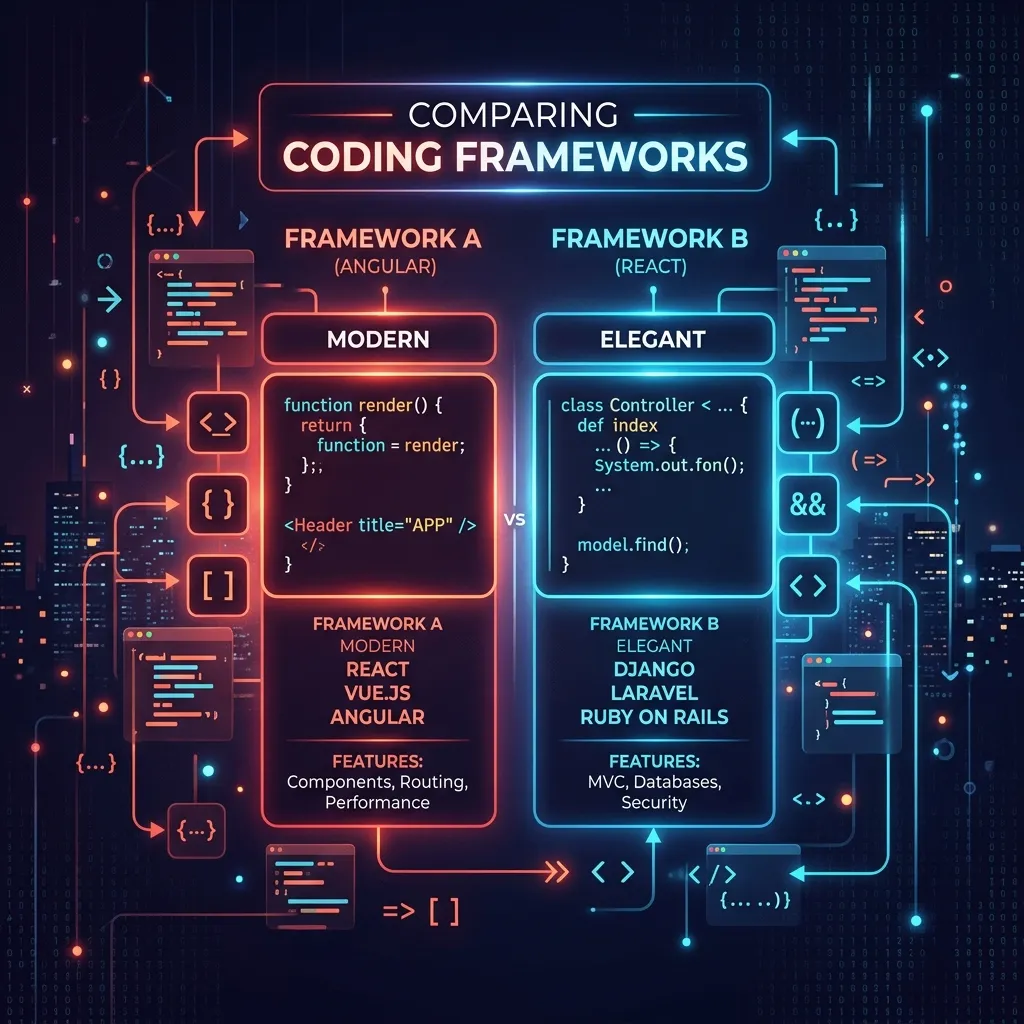
Choosing the right PHP framework shapes the success of your project for years. Laravel and CodeIgniter represent two fundamentally different philosophies — Laravel offers a comprehensive, opinionated ecosystem, while CodeIgniter delivers a lightweight, flexible toolkit. Here is a detailed, experience-driven comparison to help you decide.
Framework Philosophy: Batteries-Included vs Minimalist
Laravel follows a batteries-included approach. Out of the box, it provides authentication, authorization, database ORM, queue management, real-time events, task scheduling, email, notifications, and testing tools. You start a new project with an incredibly rich foundation and rarely need to look outside the ecosystem for core functionality.
CodeIgniter takes the opposite approach. It is a lean, minimal framework that provides routing, a database query builder, form validation, and session management — the essentials. Everything else is your choice. You select your own ORM, your own template engine, your own authentication library. This philosophy results in a smaller footprint and fewer abstractions, but more decisions for the developer.
Neither approach is inherently better. The right choice depends on your project scope, team size, and personal development preferences. For complex applications with many features, Laravel's comprehensive ecosystem saves significant development time. For simple APIs or microservices where minimal overhead matters, CodeIgniter's lean architecture shines.
Architecture and Code Structure
Laravel enforces a structured MVC architecture with dedicated directories for models, controllers, middleware, requests, resources, policies, and more. This structure scales well for large applications and teams — new developers joining a Laravel project immediately understand where to find and place code.
CodeIgniter uses a simpler MVC structure with fewer conventions. While this provides more flexibility, it also means less consistency across projects. Two CodeIgniter applications might organize code very differently, making onboarding and maintenance more challenging in team environments.
Database: Eloquent ORM vs Query Builder
Laravel's Eloquent ORM is one of its strongest features. It provides an Active Record implementation with fluent relationship definitions, eager loading, model events, mutators, and scopes. Complex database operations that would require dozens of lines of SQL can be expressed in a few elegant Eloquent calls.
// Laravel Eloquent — expressive and powerful
$users = User::with('posts')
    ->where('active', true)
    ->whereHas('orders', fn($q) => $q->where('total', '>', 100))
    ->orderBy('created_at', 'desc')
    ->paginate(15);

// CodeIgniter Query Builder — direct and simple
$users = $this->db->select('*')
    ->from('users')
    ->where('active', 1)
    ->order_by('created_at', 'DESC')
    ->limit(15)
    ->get()
    ->result();
CodeIgniter's Query Builder is lighter and closer to raw SQL. It is straightforward and easy to learn but lacks Eloquent's relationship management, lazy/eager loading, and model-level business logic. For applications with complex data relationships, Eloquent saves enormous development time.
Ecosystem and Package Availability
Laravel's ecosystem is unmatched in the PHP world. First-party packages cover every major need: Cashier for payments, Socialite for OAuth, Scout for search, Horizon for queues, Sanctum for API authentication, and Breeze/Jetstream for authentication scaffolding. Third-party packages on Packagist overwhelmingly target Laravel first.
CodeIgniter's package ecosystem is significantly smaller. While Composer packages work with CodeIgniter, most are not designed for it specifically. You often need to write more custom code or adapt general PHP libraries to work within CodeIgniter's architecture.
Performance Comparison
CodeIgniter is faster out of the box. Its minimal abstraction layer means less overhead per request. A basic CodeIgniter response is typically 2-5ms faster than an equivalent Laravel response. For simple APIs handling thousands of requests per second, this difference matters.
However, Laravel's performance with proper optimization (OpCache, Redis caching, route caching, config caching) is excellent for the vast majority of applications. The raw framework overhead becomes negligible compared to database queries, API calls, and business logic processing in real-world applications.
In practice, the performance difference rarely justifies choosing one framework over the other. A well-optimized Laravel application easily handles thousands of concurrent users, and the development speed advantages of Laravel's ecosystem typically outweigh the raw performance edge of CodeIgniter.
AI and Modern Integration
Laravel leads significantly in AI integration capabilities. The Laravel Prism package provides a unified interface for multiple AI providers (OpenAI, Anthropic, Google). The queue system handles long-running AI operations elegantly. The event system enables real-time AI-powered features. And the service container makes dependency injection of AI services clean and testable.
CodeIgniter has no dedicated AI integration packages. You can use the OpenAI PHP client directly, but you handle connection management, error handling, retry logic, and queue processing manually. For AI-powered applications, Laravel's ecosystem advantage is substantial.
Learning Curve
CodeIgniter is easier to learn for PHP beginners. Its documentation is clear, its concepts are straightforward, and its minimal abstraction means you are working closer to raw PHP. A developer comfortable with PHP can be productive with CodeIgniter within a few days.
Laravel has a steeper initial learning curve due to its many abstractions — service container, facades, middleware, form requests, resource controllers, Eloquent relationships. However, once mastered, these abstractions dramatically accelerate development speed. The investment in learning pays dividends across every future project.
When to Choose Laravel
- Complex applications: SaaS products, CRMs, dashboards, e-commerce platforms.
- Team projects: Laravel's conventions ensure code consistency across developers.
- AI-powered features: Best-in-class AI integration ecosystem.
- Rapid prototyping: Scaffolding tools generate boilerplate instantly.
- Long-term projects: Active development, strong community, predictable release cycles.
When to Choose CodeIgniter
- Simple applications: Small APIs, basic CRUD apps, lightweight websites.
- Performance-critical microservices: Minimal overhead matters at extreme scale.
- Legacy PHP migration: Easier to integrate with existing procedural PHP code.
- Limited hosting: Runs on basic shared hosting without special requirements.
- Small teams or solo developers: Less convention to learn, more flexibility.
"After building 50+ projects across both frameworks, my recommendation is clear: Laravel for anything beyond a simple CRUD application. The ecosystem, community, and development velocity are unmatched. CodeIgniter remains viable for lightweight services where minimal footprint is the priority."
Conclusion
In 2026, Laravel dominates the PHP framework landscape for good reason — its ecosystem, community, and capabilities make it the right choice for the majority of web applications. CodeIgniter retains its niche for lightweight, performance-sensitive projects where minimal overhead matters most. Evaluate your project requirements honestly, and let the scope and complexity of your application guide your decision.