
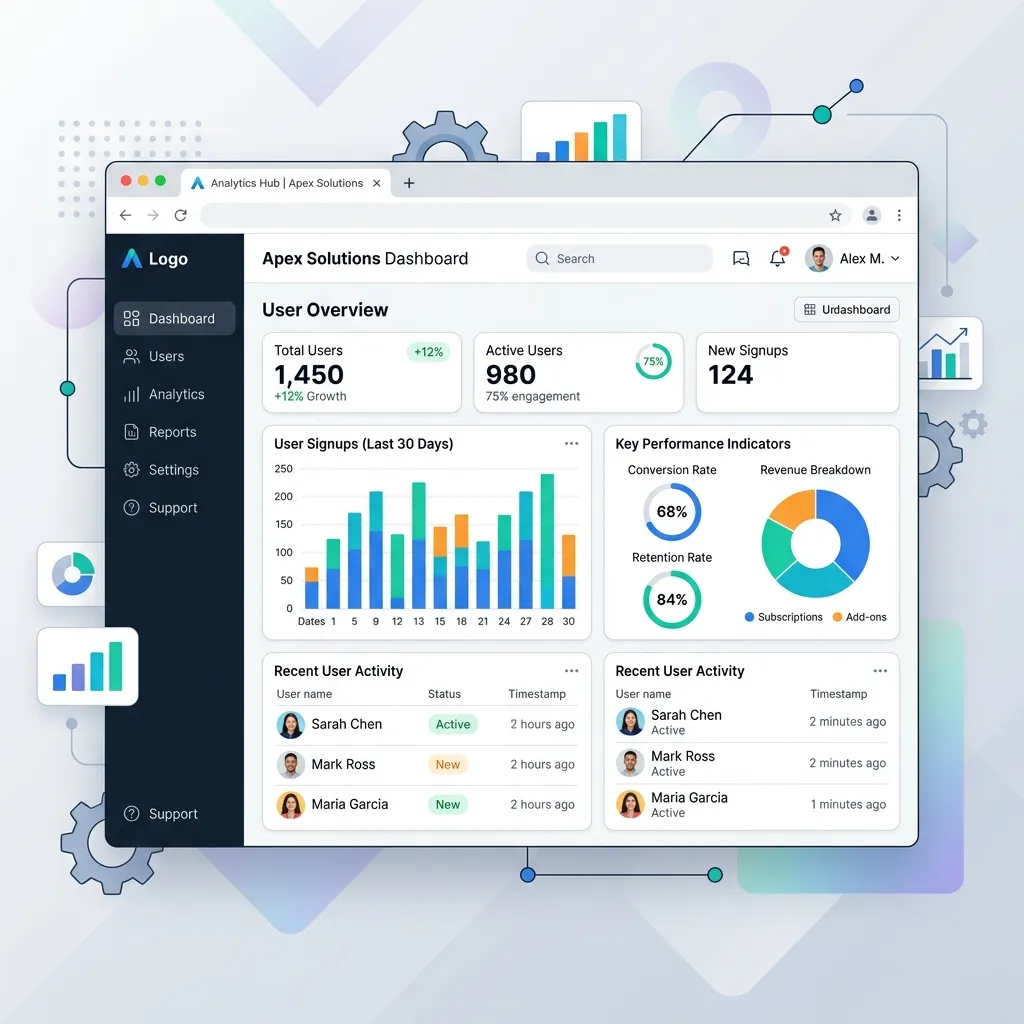
Laravel has become the dominant framework for building SaaS applications, and in 2026, adding AI features is no longer a luxury — it is a competitive necessity. This guide walks you through the complete architecture for building a modern, AI-powered SaaS application with Laravel.
Why Laravel Dominates SaaS Development
Laravel offers the most complete ecosystem for SaaS development of any PHP framework. From authentication (Sanctum, Fortify) and billing (Cashier) to real-time communication (Broadcasting, Reverb) and background processing (Queues, Horizon), Laravel provides battle-tested solutions for every SaaS requirement.
The framework's convention-over-configuration philosophy means less boilerplate and faster development cycles. Eloquent ORM simplifies complex database operations, Blade templating enables rapid UI development, and the artisan CLI automates repetitive scaffolding tasks. For SaaS products where time-to-market is critical, Laravel delivers speed without sacrificing code quality.
Laravel's vibrant ecosystem includes specialized SaaS starter kits like Spark and Tenancy that provide multi-tenancy, subscription management, and team functionality out of the box. These packages eliminate months of foundational development, allowing you to focus on building the features that differentiate your product.
Architecture: Multi-Tenancy, Queues, and Events
Sound architecture is the foundation of a successful SaaS application. The key architectural decisions you make early — database strategy, tenancy model, and event system design — will determine how well your application scales as your user base grows.
Multi-Tenancy Strategy
Choose between single-database multi-tenancy (using tenant ID columns) and multi-database tenancy (separate databases per tenant). Single-database is simpler and more cost-effective for most SaaS products, while multi-database provides stronger data isolation for enterprise customers with strict compliance requirements.
The Tenancy for Laravel package supports both approaches and handles the complexity of tenant identification, database switching, and resource isolation automatically. Configure your tenancy strategy early and apply it consistently across all models, queries, and file storage operations.
Event-Driven Architecture
Laravel's event system enables loose coupling between application components. When a user performs an action — creating an invoice, upgrading a subscription, inviting a team member — the controller dispatches an event. Listeners handle the side effects: sending notifications, updating analytics, triggering webhook deliveries, and logging audit trails.
// Event-driven SaaS architecture example
class InvoiceCreated
{
    public function __construct(
        public readonly Invoice $invoice,
        public readonly User $user
    ) {}
}

// Multiple listeners handle different concerns
class SendInvoiceEmail { /* ... */ }
class UpdateRevenueMetrics { /* ... */ }
class TriggerWebhook { /* ... */ }
class LogAuditTrail { /* ... */ }
Adding AI Features: Smart Dashboards and AI Assistants
AI features differentiate modern SaaS products from competitors. The most impactful AI additions for SaaS applications include intelligent dashboards, natural language interfaces, automated insights, and predictive analytics.
Smart Dashboards
Traditional dashboards display static charts and tables. AI-powered dashboards go further — they analyze data patterns, identify anomalies, and proactively surface insights that users would otherwise miss. When revenue drops unexpectedly, the AI dashboard highlights the specific customer segment, time period, and potential cause without the user needing to dig through reports manually.
AI Assistant Integration
Adding an AI assistant to your SaaS product allows users to interact with their data through natural language. Instead of navigating complex filter interfaces, users can ask "Show me all invoices from Q1 that are overdue" and receive instant results. The assistant understands your data model and translates natural language queries into Eloquent operations.
Implement the AI assistant as a dedicated service layer that receives natural language input, determines intent, constructs the appropriate database query, executes it within the user's permission scope, and returns formatted results. This approach keeps AI logic isolated from business logic while providing powerful query capabilities.
Payment Integration with Stripe and Cashier
Laravel Cashier provides a fluent interface for managing Stripe subscriptions, one-time payments, invoicing, and payment method management. For SaaS products, Cashier handles the critical billing infrastructure that directly impacts revenue.
Configure your subscription plans with appropriate feature gates. When a user subscribes to a specific plan, Cashier manages the billing cycle while your middleware enforces feature access based on the active subscription. This ensures premium features are accessible only to paying customers while maintaining a smooth upgrade experience.
Implement usage-based billing for AI features using Cashier's metered billing support. Track AI token consumption per user and charge based on actual usage. This pricing model aligns costs with value delivery — users who consume more AI processing pay proportionally more, keeping your margins healthy as AI costs scale.
Deployment and CI/CD Pipeline
Modern SaaS deployment requires automated CI/CD pipelines that test, build, and deploy your application reliably. Laravel Forge and Envoyer simplify server provisioning and zero-downtime deployments, while GitHub Actions or GitLab CI handle automated testing and quality checks.
Your CI/CD pipeline should include automated PHPUnit tests, static analysis with PHPStan, code style checks with Laravel Pint, security vulnerability scanning, and database migration testing. Every code change passes through this pipeline before reaching production, ensuring consistent quality and preventing regressions.
For zero-downtime deployments, use atomic deployment strategies that prepare the new release in a separate directory, run migrations, warm caches, and switch the symlink only after everything is verified. This approach ensures users never experience downtime during deployments.
Scaling Strategies
Plan your scaling strategy before you need it. Laravel applications scale horizontally by adding more web servers behind a load balancer. Redis provides shared session storage and cache across multiple servers, while Horizon manages queue workers efficiently.
For database scaling, implement read replicas for heavy query loads and consider database partitioning for tables that grow beyond tens of millions of rows. Laravel's database configuration supports read/write splitting natively, routing SELECT queries to replicas while directing writes to the primary database.
AI features require particular attention to scaling. LLM API calls are expensive and latency-sensitive. Implement aggressive caching for repeated queries, use queue workers for non-real-time AI operations, and set per-user rate limits to prevent any single user from consuming disproportionate AI resources.
Real-World Cost Breakdown
Understanding the true cost of running a SaaS application helps with pricing decisions and financial planning. Here is a realistic monthly cost breakdown for a Laravel SaaS with AI features serving 1,000 active users:
- Hosting (Managed VPS): $50-200/month depending on traffic and performance requirements.
- Database (Managed MySQL/PostgreSQL): $30-100/month for production-grade managed databases.
- AI API Costs (OpenAI/Anthropic): $100-500/month depending on feature usage intensity.
- Email Service (Postmark/SES): $10-50/month for transactional emails.
- CDN and Storage (CloudFlare/S3): $10-30/month for static assets and file storage.
- Monitoring (Sentry/Pulse): $20-50/month for error tracking and performance monitoring.
- Total: $220-930/month — sustainable with as few as 50-100 paying customers at typical SaaS price points.
"The best SaaS products solve real problems elegantly. Laravel provides the engineering foundation, AI provides the intelligence, and your domain expertise provides the value that customers pay for."
Conclusion
Building a SaaS application with Laravel and AI in 2026 is more accessible than ever. The Laravel ecosystem provides battle-tested solutions for every infrastructure concern — authentication, billing, queues, real-time communication, and deployment. AI integration adds intelligent features that differentiate your product and create defensible competitive advantages. The combination of Laravel's engineering excellence and AI's capability amplification makes this stack the optimal choice for modern SaaS development.